












You reach for the necklace you have been picturing all morning, and it comes out of the drawer knotted around two others. A stud earring has lost its partner somewhere. The bracelet you wore last week has gone dull. Every piece is technically still there, but none of it is ready to wear.
Most jewelry damage does not happen while you are wearing it. It happens in the hours and years between wears, when chains rub against each other, silver meets open air, and delicate settings sit under something heavier. Good storage is not about aesthetics. It is about keeping pieces in the same condition you brought them home in.
This guide walks through how to organize jewelry by category, material, and how often you actually wear it. You will learn which storage methods protect which pieces, how to keep chains from tangling, and what to do differently for fine jewelry and travel.
Start With a Full Inventory Before You Buy Any Organizer
The most common mistake is buying a storage solution first and fitting your collection into it afterward. Empty every drawer, dish, and pouch onto a clean surface, then sort by these four buckets:
- Daily rotation: Pieces you reach for several times a week. These need to be visible and easy to grab.
- Occasional wear: Worn monthly or seasonally. Accessible but not front and center.
- Fine and high value: Diamonds, precious gemstones, gold, and anything with sentimental or insured value.
- Needs attention: Broken clasps, missing stones, tarnished pieces, and orphaned earrings.
That last pile matters more than it looks. Set it aside and handle it before you organize anything else, because storing a damaged piece just means rediscovering the problem months later. Our in-house team handles jewelry repair for everything from clasp replacements to restringing, and it is worth clearing that backlog first.
While you sort, take photos. A simple phone album of your collection helps with insurance documentation and makes it far easier to notice if something goes missing.
Match the Storage Method to the Piece

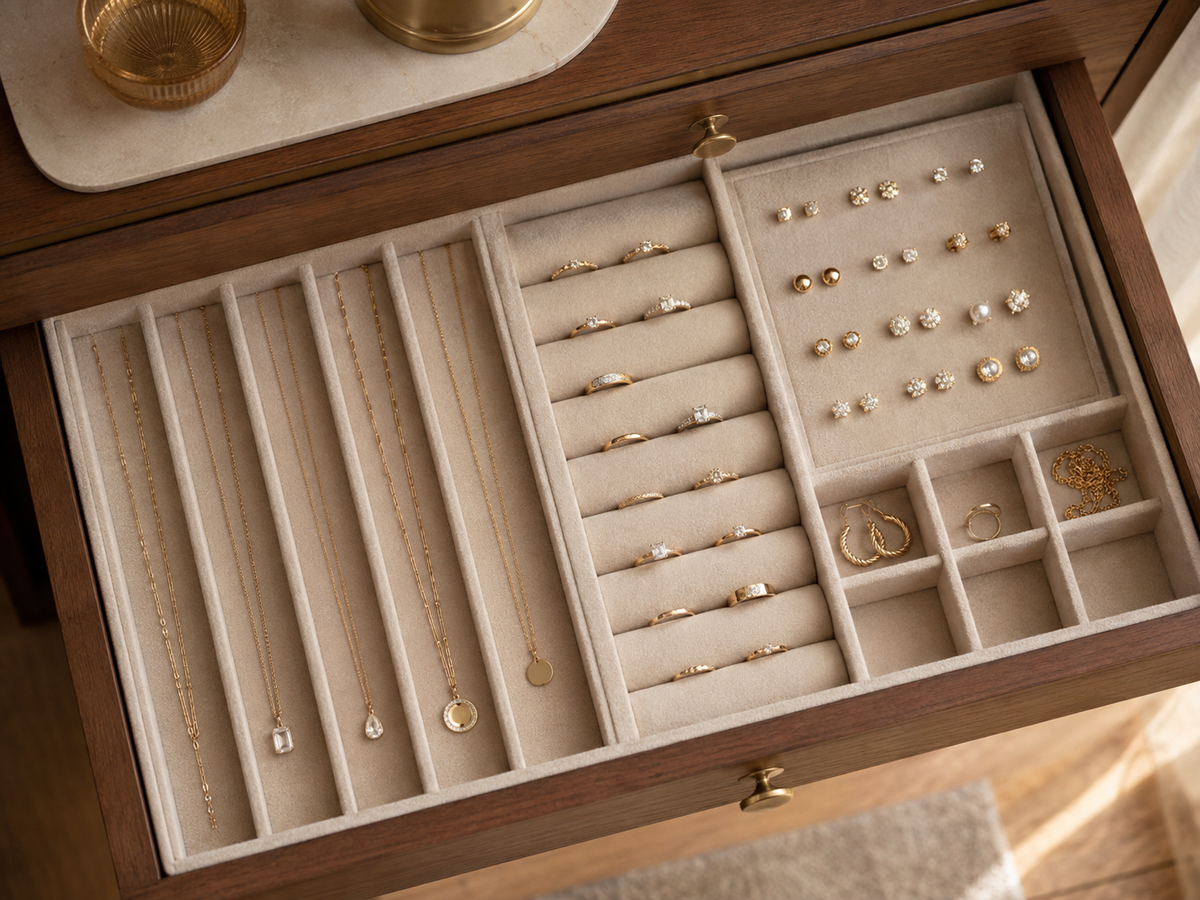
Different jewelry types fail in different ways. Chains tangle, studs disappear, and soft gold scratches against harder stones. These jewelry storage ideas are organized by what each category actually needs.
|
Jewelry type |
Best storage method |
What it prevents |
|
Necklaces and chains |
Individual hooks or a hanging organizer |
Tangling, kinking, clasp strain |
|
Stud earrings |
Foam insert, ice cube tray, or slotted tray |
Lost backs, separated pairs |
|
Drop and hoop earrings |
Hanging bar or perforated panel |
Bent posts, scratched finishes |
|
Bracelets and bangles |
Bracelet bar, T-bar stand, or padded roll |
Warping, surface scratches |
|
Rings |
Slotted ring roll or individual compartments |
Prong damage, stone-on-metal scratching |
|
Watches |
Watch roll or cushioned case |
Crystal scratches, bracelet stretching |
|
Delicate or antique pieces |
Individual soft pouches |
Chipping, fabric snags, oxidation |
Principles That Apply to Every Category
- Give hard stones their own space. Diamonds and sapphires will scratch gold, pearls, opals, and softer stones on contact.
- Never stack pieces loosely. Weight on top of a delicate setting is how prongs bend and links flatten.
- Keep pairs together physically. Earring pairs stored in the same slot are far less likely to become singles.
If your rings or bracelets tend to accumulate on nightstands and bathroom counters, place a small dish in each of those spots. Working with your habits beats fighting them.
How to Store Necklaces Without Tangling

Chains tangle because they move. Any storage that lets a necklace shift, fold back on itself, or share space with another chain will eventually produce a knot. The fix is keeping each chain hanging straight and separated.
Storage Methods, Ranked From Most to Least Effective
- Individual wall hooks or a hanging organizer. Each chain hangs vertically at full length with nothing touching it. This is the gold standard for anyone with a serious necklace collection.
- A necklace tree or T-bar stand. Good for daily-wear pieces you want visible. Limit each arm to one or two chains.
- Clasped through a straw or tube. Thread one end of the chain through a drinking straw and clasp it. Physically impossible to knot. Ideal for fine chains.
- Individual pouches, one necklace per pouch. Best for travel and long-term storage of pieces you rarely wear.
- Divided drawer with each chain laid flat and extended. Workable, but only if the chain stays fully straight and never overlaps a neighbor.
Two Habits That Matter More Than Any Organizer
- Always clasp before storing. An open clasp is a hook looking for something to catch.
- Store layering necklaces separately. The chains you wear together are the ones most likely to knot together.
Whether you are storing a delicate pendant or a heavier statement chain, the principle holds. Our necklaces range from fine everyday layering pieces to substantial designer chains, and the finer the chain, the more it benefits from hanging storage.
How to Store Fine Jewelry and High Value Pieces

Fine jewelry deserves a different standard than costume pieces. The materials are softer than people expect, the settings are more precise, and the replacement cost is real.
What Fine Jewelry Needs
- A lined, compartmentalized box. Soft fabric interiors prevent surface scratches. Compartments prevent contact between pieces.
- Stable temperature and humidity. Skip the bathroom entirely. Steam accelerates tarnish and can loosen adhesives in some settings.
- Darkness. Some gemstones, including amethyst and kunzite, fade with prolonged light exposure.
- A discreet location. Not the top dresser drawer or the bedside table. Both are the first places a thief checks.
- A home safe for the highest value pieces. Worth it for anything you would struggle to replace.
Pearls Are Their Own Category
Pearls need air circulation, so avoid sealed plastic. Store them flat rather than hanging, since gravity stretches the silk thread over time. Keep them away from other jewelry entirely, because pearls are among the softest materials in any collection.
Keep Documentation With the Jewelry
Appraisals, certificates, and purchase records belong alongside the pieces themselves, and your coverage should match current value. We offer jewelry and watch insurance through Zillion for exactly this reason. If watches make up a meaningful part of your collection, our guide to luxury watch insurance covers what standard homeowners policies typically miss.
How to Keep Jewelry From Tarnishing
Tarnish is a chemical reaction between metal and the sulfur and moisture in the air. You cannot stop it completely, but you can slow it down significantly.
|
Metal |
Tarnish risk |
Storage priority |
|
Sterling silver |
High |
Anti-tarnish pouch or strips, airtight when stored long term |
|
Gold plated and vermeil |
Moderate |
Individual pouches, minimal friction, no moisture |
|
14k and 18k gold |
Low |
Standard lined storage, occasional polishing |
|
Platinum |
Very low |
Standard lined storage |
|
Costume and base metals |
High |
Keep dry, expect a shorter lifespan |
Practical Prevention Steps
- Add anti-tarnish strips to drawers and boxes, and replace them every six months.
- Toss silica gel packets into storage compartments to absorb ambient moisture.
- Put jewelry on last, after perfume, lotion, and hairspray have fully dried.
- Wipe pieces with a soft cloth after wearing to remove skin oils and residue.
- Store silver in airtight bags for anything you will not wear for several months.
Rotation matters too. Jewelry worn regularly tarnishes less, because the natural friction against skin and clothing keeps the surface clean. If you are building out a set of pieces you can wear often, our guide to casual everyday jewelry is a useful starting point.
Travel Jewelry Storage That Actually Protects

Travel is where organized collections come undone. Movement, pressure, and unf
amiliar surroundings all work against you.
Before You Pack
- Bring only what you will realistically wear. Every extra piece adds risk.
- Leave irreplaceable and heirloom pieces at home.
- Photograph everything you are bringing.
- Confirm your insurance covers items away from home.
How to Pack Each Piece
|
Item |
Packing method |
|
Necklaces |
Clasped and threaded through a straw, or in individual zip pouches |
|
Earrings |
Pushed through a button or foam disc to keep pairs together |
|
Rings |
Zipped ring roll, never loose in a pocket |
|
Bracelets |
Rolled in a soft cloth or padded travel roll |
|
Watches |
Individual watch pouch or hard travel case |
Carry it on. Always. Checked luggage gets lost, and most airline liability limits exclude jewelry entirely. In the hotel, use the room safe for anything valuable, and do a final sweep of the bathroom counter and nightstand before you check out. Those two surfaces account for a remarkable share of forgotten earrings and rings.
Jewelry Worth Organizing Well
A well-organized collection changes how you wear it. Pieces you forgot you owned come back into rotation. Getting dressed takes less time. And the jewelry itself lasts longer, because most wear and damage traces back to how it was stored, not how it was worn.
Start with the inventory, fix what needs fixing, and match each piece to storage that suits its material. Whether you are caring for a collection built over decades or beginning one now, our fine jewelry collection offers pieces made to be worn and passed down.
If you have inherited pieces that need assessment, restoration, or simply a second opinion on how to store them, reach out to our team in Calabasas. Four generations of experience are behind every conversation.
Frequently Asked Questions
What is the best way to organize jewelry at home?
Start by sorting your collection into daily wear, occasional wear, fine jewelry, and pieces needing repair. Then match storage to each category: hanging organizers for necklaces, compartmentalized trays for rings and earrings, and lined boxes for fine pieces. Keeping daily pieces visible and accessible is what makes any system stick long term.
How do you keep necklaces from getting tangled?
Hang each necklace individually so it stays straight and separated from other chains. Always fasten the clasp before storing, since an open clasp catches on nearby chains. For fine chains and travel, threading the necklace through a drinking straw before clasping it makes tangling physically impossible.
Should jewelry be stored in a box or hung up?
It depends on the piece. Necklaces and long chains do best hanging, where gravity keeps them strai
ght. Rings, earrings, bracelets, and fine jewelry belong in a lined box with individual compartments that prevent scratching and contact between pieces.
How do you store jewelry so it does not tarnish?
Keep it dry, dark, and away from open air. Anti-tarnish strips and silica gel packets in your storage compartments make a noticeable difference, and airtight bags work well for sterling silver you will not wear for several months. Avoid bathroom storage entirely, since humidity accelerates tarnish.
Is it okay to store jewelry in the bathroom?
No. Bathroom humidity from showers and baths speeds up tarnish on silver and gold plating, and repeated moisture exposure can weaken adhesives in certain settings and loosen strung pieces. A bedroom drawer or closet with stable temperature and low humidity is a much better choice.
How should you pack jewelry for travel?
Bring only what you will actually wear and leave heirloom pieces at home. Use a dedicated travel roll or individual pouches so nothing shifts or presses against anything else, and keep earring pairs together by pushing them through a button or foam disc. Always pack jewelry in your carry-on, since most airlines exclude it from checked baggage coverage.